by Emilia Cazanescu

Emilia Cazanescu came to André’s apartment expecting takeaway, wine, and a quiet night together. She found an ivory blouse, a familiar coat, and the unsettling discovery that sometimes the smallest gestures make the biggest declarations.
I arrived after nine, tired from a day spent negotiating delivery dates with a designer who considered calendars an insult to creativity. Rain had followed me from the Métro, the fine persistent kind that never quite justified an umbrella but eventually found its way beneath your collar.
André opened the door before I had finished texting Léa to tell her I was staying over.
“You’re late,” he said. He had removed his jacket but not his tie, and the sleeves of his white shirt were folded once at the wrist.
There was something about André at the end of a working day that I preferred to the immaculate version the rest of Paris received. The slight disorder made him seem more accessible.
“Seven minutes,” I said, stepping inside.
“Eight.”
I looked at him as he took the paper bag from my hands. “You timed me?”
“I noticed.”
He kissed me lightly on the forehead before turning toward the kitchen. It was such an ordinary gesture that I almost failed to notice how extraordinary it would have seemed to me just a month or two ago.
Dinner came from the Italian restaurant downstairs because neither of us had the energy to pretend we intended to cook. We ate at the narrow table beside the windows, with the city reflected faintly in the glass behind André’s shoulder.
Paris had become blurred by rain. Headlights moved along the street below in pale ribbons, appearing and disappearing between the buildings.
We talked about work despite having agreed not to. André complained about a collection he had seen that afternoon. I defended one of the coats without having seen it, mostly because irritating him remained one of the more reliable pleasures of our relationship. He accused me of contrarianism. I accused him of confusing commercial certainty with taste. Somewhere during the argument he loosened his tie and opened the top button of his shirt.
I lost my train of thought.
He noticed. His expression changed by perhaps half a degree.
“Continue,” he said.
“I’ve forgotten what I was saying.”
“That must be difficult for you.”
I drank my wine rather than reward him.
There were evenings when loving André felt profound, and evenings when it felt suspiciously like wanting to throw bread at him across a table. I had learned not to consider these opposing conditions.
Later, while he cleared the plates, I went into the bedroom to change. I had left an ivory silk blouse there the previous weekend and intended to wear it to work the following day.
At least, I thought I had left it there. It wasn’t on the chair, or folded on the dresser where André usually placed anything of mine he discovered after I had gone home.
“André,” I called.
His answer came from the kitchen beneath the sound of running water. “Quoi?”
“Have you seen my blouse?”
There was a pause long enough to suggest he required more information.
“The ivory one,” I added. “Silk. Narrow cuffs.”
“Wardrobe,” he finally replied. “Your side.”
I had already reached for the handle when the last two words settled.
Your side.
I opened the doors. For a moment I genuinely thought I had opened the wrong section.
André’s wardrobe had always been exactly what one would expect of him. Dark jackets arranged by weight, shirts spaced evenly, trousers folded with a precision bordering on moral judgment. Nothing crowded anything else. Even his clothes appeared to understand personal boundaries.
Now the right third of it was almost empty.
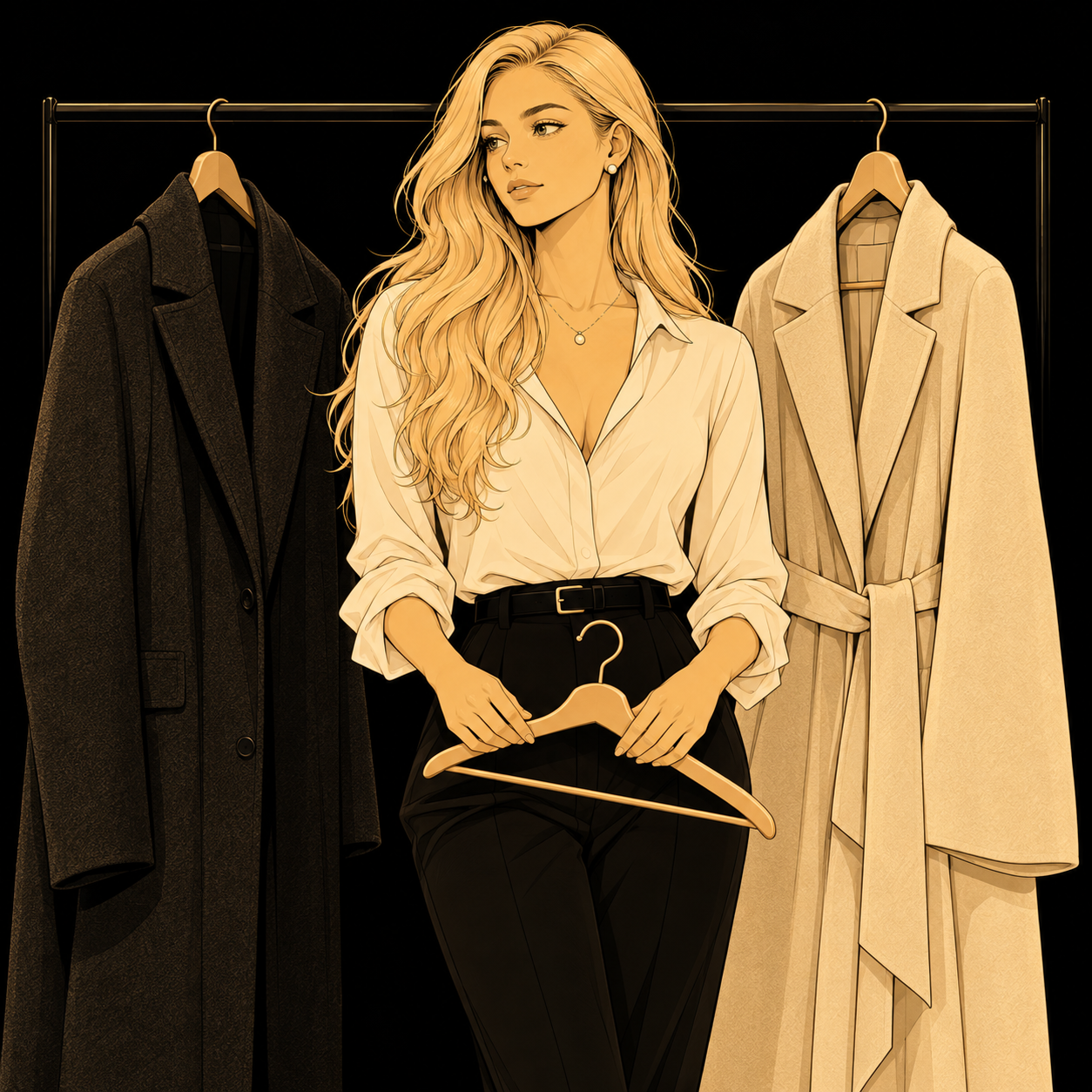
My blouse hung there, freshly pressed. Beside it was the black dress I had worn to dinner several weeks earlier and subsequently forgotten. There were six or seven empty wooden hangers after that, all facing the same direction. Below them, one of the drawers stood slightly open. Inside I could see a folded T-shirt, stockings, underwear, the soft grey cashmere cardigan I had accused Coco of hiding.
But it was the coat that stopped me.
My pale wool coat hung beside André’s charcoal one. I had been looking for it for nearly two weeks.
I touched the sleeve, pressing the fabric between my fingers as if some explanation might have been stitched into it. The coat had not been lost. It had simply been here, hanging beside his, with the quiet confidence of something that expected me to return.
Behind me, the bedroom door moved. “Did you find it?”
I kept my hand on the coat.
André came closer, and I watched his reflection appear beside mine in the wardrobe mirror. He looked first at me, then at the clothes, then back at me. His brow tightened slightly. “Is there not enough room?”
I laughed before I could stop myself. He looked genuinely perplexed. “What?”
“Nothing.”
“Emilia.”
“When did you do this?”
“Do what?”
I turned and looked at him properly. “This.”
His eyes moved toward the wardrobe again. Understanding arrived slowly, followed by an expression so completely untroubled that it made the ache beneath my ribs feel worse.
“You kept leaving things here,” he said.
“That is your explanation?”
“What explanation would you prefer?”
“I don’t know. Something involving advance notice.”
He leaned one shoulder against the wardrobe. “You wanted advance notice that I was moving six shirts?”
There was the beginning of a smile at his mouth. I wanted to be amused, and part of me was. Another part remained fixed on those empty hangers.
I had always imagined permanence as something announced. It arrived with conversations conducted carefully over tables. With decisions. Keys. Invitations. I had never considered that it might happen without permission.
“When?” I asked.
André thought about it. “A week or two ago.”
“You didn’t tell me.”
“I didn’t realise it required telling.”
“That’s the part I find alarming.”
His amusement disappeared when he heard something beneath the words. He stepped away from the wardrobe and stood in front of me, not touching me yet.
André had become good at that. Earlier in our relationship he had sometimes tried to solve my silences. Now he understood that they were rooms and that occasionally I needed him to wait at the door.
I looked back at my coat. “I think I’ve spent most of my life making sure everything belongs somewhere. My work belongs at work. My apartment is mine. Yours is yours. Even relationships…” I hesitated, irritated by the inadequacy of the word. “There are edges. I like knowing where they are.”
“And this moved one?”
“Yes.”
He considered that without dismissing it. “Do you want me to move it back?”
The question was sincere. That was what undid me.
“No.”
He waited.
I traced the seam of the coat with my thumb. “I think I’ve been measuring love by how much of myself I could keep untouched by it.”
For several seconds, the apartment seemed very quiet. Finally he reached for my hand.
“I made room for your clothes, Emilia,” he said. “I didn’t remove you from your own life.”
“I know.”
“You still have your apartment.”
“I know.”
“Your work.”
“Yes.”
“Your terrifying little dog.”
I looked at him. “Coco likes you.”
“Coco tolerates me because I know where you keep the biscuits.”
“That is how she likes people.”
His thumb moved across the inside of my wrist. “Then nothing has been taken from you.”
I looked down at our hands. “No,” I said. “Something has been added.”
The sentence embarrassed me almost immediately. It was too naked, too close to saying precisely what I meant. I had always preferred metaphor because metaphor leaves an emergency exit.
André gave me none.
He lifted my hand and kissed my fingers. I moved toward him and kissed his lips.
For an instant he seemed surprised, and then his hand came to my waist. The kiss deepened slowly, without the old uncertainty that had once made every touch between us feel like a negotiation.
This was different. I knew him now.
I knew the faint roughness along his jaw at the end of the day and the shape his mouth made immediately before he laughed. I knew that when his hand settled against the small of my back, his thumb would move once before becoming still.
And he knew me. That remained the more dangerous fact.
He kissed along my cheek and down toward my neck, slowly enough that I felt every change in his breathing. My hands moved beneath the open collar of his shirt, finding warm skin. He drew me closer until the wardrobe pressed lightly against my back.
“André,” I whispered. He stopped immediately and looked at me. I almost smiled. “I’m attempting to have an emotional revelation.”
His expression remained solemn for approximately one second. “Should I leave?”
I pulled him back by the shirt. “Don’t be ridiculous.”
His laugh disappeared into my mouth.
We reached the bed eventually. His shirt landed somewhere near the wardrobe and the rain continued against the windows. There was no urgency between us, only the pull of bodies that no longer needed to ask whether they were wanted.
He touched me with the attention I had come to understand as one of his quietest forms of affection. I ran my fingers through his hair and watched the controlled version of André slowly disappear.
Once, being seen that closely would have made me retreat. Instead, when he looked at me, I stayed.
Much later, I woke because I was thirsty.
The room had cooled. André slept beside me, one arm stretched into the space I had left behind. I found his shirt on the floor and put it on before walking barefoot to the kitchen.
On the way back, I noticed that the wardrobe door was still open. My coat hung in the darkness. Pale grey beside charcoal. I stood in front of it with my glass in both hands. There was an empty hanger beside mine, and another after that.
I could take the coat home in the morning. I could take the dress and the blouse and the ridiculous cardigan I had blamed on Coco. I could return everything to its proper place and restore the clean geography of my life.
Nothing prevented me. That seemed important.
I closed the wardrobe gently.
When I returned to bed, André shifted without waking. His hand moved across the sheet until it found my waist, then became still.
I lay beside him listening to the rain.
For years I had thought belonging meant surrendering territory. It had never occurred to me that love might do the opposite.
Sometimes, it simply made room.
Poetic and cerebral, Emilia lives at the edge of Parisian elegance and Romanian memory. In Paris Undressed, she models poise but writes vulnerability, inviting you into a story that feels both polished and raw. Beneath her quiet exterior lies a girl unafraid to let silence speak louder than love. Follow Emilia on Instagram and TikTok.