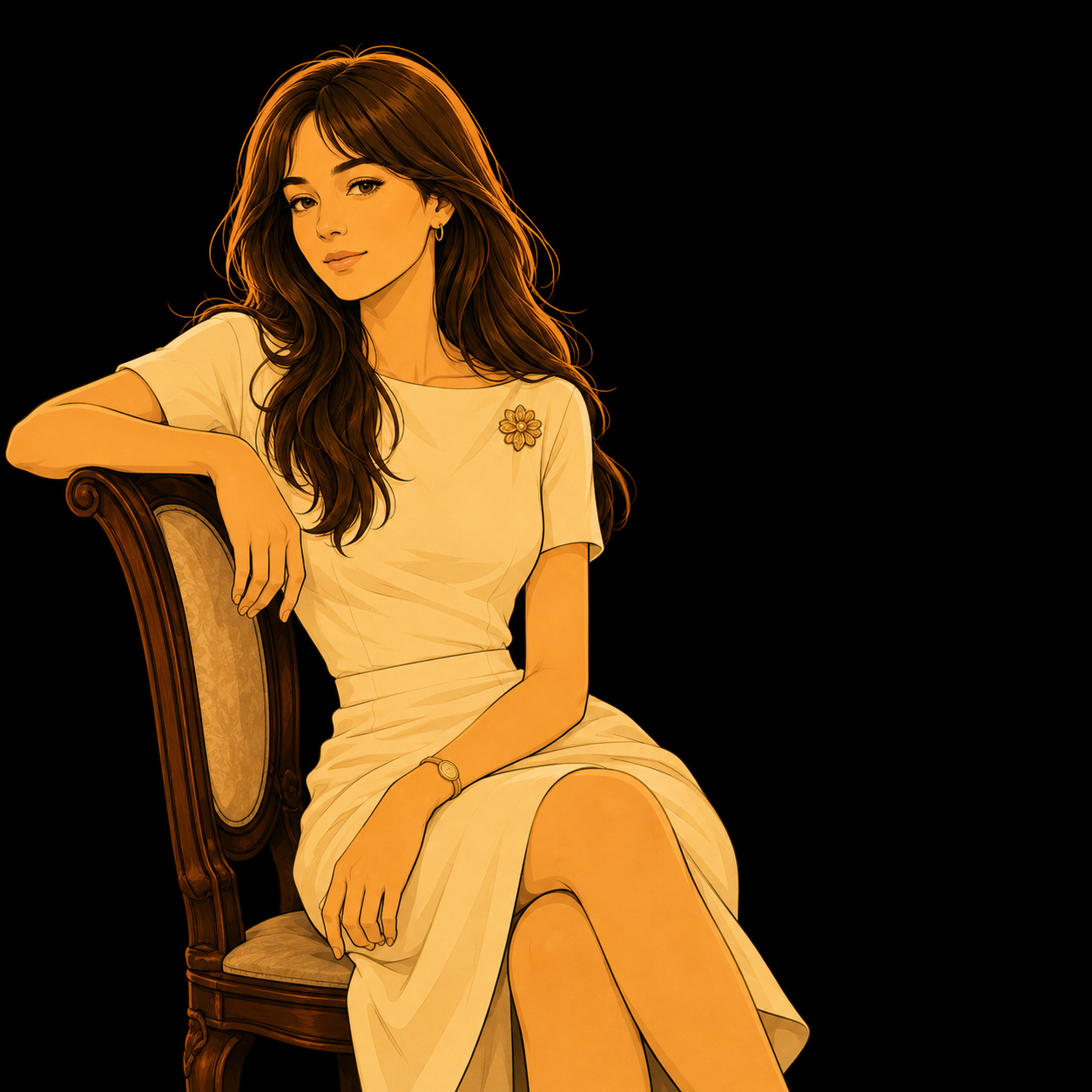
by Lara Strathmore
Lara Strathmore returned to her family's Greenwich home expecting another evening of polite conversation, carefully arranged introductions, and the familiar obligation to be agreeable. She hadn't expected a dinner party to make her question how much of a life could be spent becoming the person everyone else wanted you to be.
My mother had a particular way of describing dinner parties that made them sound less like social obligations and more like small acts of domestic generosity.
“Just a few friends, darling.”
It was a phrase I had learned to distrust before I was old enough to understand what a seating plan was. A few friends usually meant twelve people, two arrangements of flowers large enough to obstruct conversation, and a menu that had been revised three times despite being prepared by someone who knew perfectly well how to cook.
By the time the car turned through the gates of our house in Greenwich, I had already decided not to be difficult.
It was a decision I made frequently on the journey home. Sometimes I managed to keep it until dessert.
The house appeared through the trees in its usual state of architectural self-satisfaction. Pale stone, symmetrical windows, a gravel driveway that curved with unnecessary elegance toward the front steps. My father liked to say the property had character, although I had always suspected he meant it had history, which was a different thing entirely. Character required the possibility of being disliked.
I stepped out into the fresh air, smoothing the front of my navy skirt as the driver retrieved my overnight bag. The lawns had been cut recently. Somewhere beyond the west gardens, I could hear the distant mechanical rhythm of the groundskeeper finishing whatever task the season had made necessary.
Everything looked immaculate. It always did.
My mother was waiting in the entrance hall when I came inside. She wore cream trousers, a fine cashmere sweater, and the small pearl earrings she had worn for as long as I could remember. Her hair was pinned loosely at the back, although the arrangement had probably taken twenty minutes to achieve.
“Lara, darling.”
She kissed both my cheeks and held me at arm’s length, looking me over with the affectionate concentration of someone inspecting a valuable object returned from restoration.
“You look tired.”
“Hello to you too, Mum.”
“Have you been sleeping?”
“Occasionally. Between lectures.”
She smiled, but her attention had already moved to my skirt. I watched the calculation happen behind her eyes, the quiet assessment of length, fabric, and what the evening might require of me.
“You’re not wearing that tonight, are you?”
I looked down. “I hadn’t planned to wear my travelling clothes to dinner.”
“Of course not. I only wondered.”
My mother wondered a great many things. Almost all of them came disguised as questions whose answers she had already decided.
She took my arm and led me toward the staircase, asking about Columbia, my classes, whether I was eating properly, and whether I had heard from a girl named Caroline whose mother apparently remained interested in the possibility of our friendship.
I answered as we climbed. Yes, classes were going well. Yes, I was eating. No, I hadn’t seen Caroline, although I was reasonably certain she had moved to Boston two years earlier.
At the landing, my mother paused. “Oh, and Edward will be here tonight.”
I looked at her. “Edward?”
“Whitmore. You remember Edward.”
Of course I remembered Edward Whitmore. Our families had spent summers in overlapping parts of Cape Cod for most of my childhood. He was six years older than me, had attended Princeton, and possessed the sort of handsome face that seemed designed to reassure parents rather than excite daughters.
“I thought he lived in London.”
“He’s back in New York now. Working in finance.”
“How unexpected.”
My mother ignored the tone. “He’s doing terribly well. And he’s recently single, I believe.”
There it was, I thought, turning toward my bedroom. “Shall I ask the florist to prepare my bouquet now, or would that be presumptuous?”
“Lara.”
“I’m only trying to be efficient.”
She gave me the look she had perfected during my adolescence, a mixture of disappointment and patience that suggested my behavior was a temporary medical condition.
“Just be pleasant tonight, darling.”
I smiled.
Pleasantness was something I had been taught before multiplication.
My childhood bedroom had been redecorated when I was seventeen, although very little had actually changed. The pale blue walls remained, along with the cream curtains and the antique writing desk beside the window. My mother had replaced the floral bedspread with something more restrained, as though my transition into adulthood could be measured by a reduction in pattern.
I unpacked slowly, hanging my ivory silk blouse beside the wardrobe and laying a dark wool skirt across the bed. The clothes were mine, chosen in Manhattan, paid for with money I understood came from a world I was increasingly inclined to criticize but not yet prepared to abandon.
There was a particular hypocrisy in that. I knew it. I simply hadn’t found a way to resolve it that didn’t involve becoming considerably less comfortable.
On the dressing table stood a photograph of my parents taken shortly after their wedding.
My father looked almost exactly as he did now, only younger around the eyes. He had one hand resting on my mother’s waist, his expression confident and slightly amused, as though marriage were another successful decision in a life composed largely of judgements that had proved him right.
My mother was different.
Her hair was loose, caught by the wind, and she was laughing at something beyond the frame. Not smiling for the photographer. Actually laughing, her head turned slightly away from the camera.
I picked up the photograph and studied her face.
There was something unfamiliar about that expression. A kind of carelessness I couldn’t remember seeing in her, except occasionally after two glasses of wine when my father was away and the house belonged, briefly, to the two of us.
I wondered what had made her laugh. Then I put the photograph down, changed into my blouse, and began fastening the buttons.
By seven, I looked exactly as I was supposed to.
Edward was standing beside the fireplace when I entered the drawing room, holding a glass of champagne and listening to my father describe something involving interest rates.
He had grown into his appearance rather well. Tall, fair-haired, with an expensive suit and the relaxed posture of a man who had never seriously questioned whether he belonged in a room. His face was pleasant, his smile immediate.
“Lara Strathmore.” He stepped forward and kissed my cheek. “God, it’s been ages.”
“Long enough for you to develop an English accent?”
He laughed. “Is it that obvious?”
“Only on words you want people to notice.”
He looked genuinely amused, which made me like him a little more than I had intended.
We talked about New York, his time in London, and the curious experience of returning to a city that had continued existing without him. He asked about Columbia and seemed interested until I mentioned psychology, at which point his expression settled into the familiar politeness people adopted when confronted with a subject they considered intellectually respectable but economically weak.
“Fascinating,” he said. “What do you do with that afterwards?”
“Understand people, hopefully.”
“No, I mean professionally.”
“I know what you meant.”
He smiled again, although this time with slightly less certainty.
“Well, you’ve got time to work it out. My sister changed her mind about three times before settling down.”
“How reassuring.”
He didn’t seem to notice the edge in my voice. Or perhaps he did and was too well brought up to acknowledge it.
My mother appeared beside us carrying no drink, which meant she was supervising rather than participating.
“Edward, you must tell Lara about your new apartment. It’s in Tribeca, isn’t it?”
“Yes. Just moved in.”
“Such a lovely area,” she said. “And so convenient for everything.”
I watched her move the conversation toward property, employment, and the advantages of living in the same city. She did it so elegantly that Edward seemed to believe he had arrived at each subject himself.
My mother had never studied psychology, yet sometimes I thought she understood influence better than anyone in my department.
Dinner was announced shortly afterwards. As we moved toward the dining room, Edward offered me his arm and I took it. There were worse things than being escorted to dinner by a handsome man whose greatest failing appeared to be predictability.
I could think of several. Most involved men who had made unpredictability something of an art.
The dining room glowed beneath the chandelier. Candles reflected in the polished silver, and white roses stood in low arrangements along the center of the table. My mother had chosen them because they wouldn’t interfere with conversation, although I suspected their real purpose was to suggest that beauty could be both extravagant and discreet.
I found my place card beside Edward’s. Naturally.
My father sat at the head of the table, looking pleased with the gathering in the quiet way he looked pleased with most things he had arranged. To his left sat a couple who owned a house in Palm Beach. Across from me was a woman named Margaret whose principal occupation, as far as I could determine, involved knowing things about people before they had decided to tell anyone.
The first course arrived. Conversation moved comfortably between holidays, property, university admissions, and a recent charity auction at which someone had apparently paid an extraordinary amount for a weekend on a yacht.
I listened, contributed when necessary, and watched my mother.
She knew when to interrupt a story before it became tedious. She noticed when Margaret’s glass was empty and when my father wanted the salt without asking for it. When a guest mentioned a mutual acquaintance whose marriage had recently ended, my mother redirected the conversation so gracefully that nobody appeared to notice the rescue.
I had grown up watching her do these things. Until that evening, I had rarely considered them work.
“So, Lara,” Margaret said, turning toward me. “Your father tells us you’re studying psychology.”
“That’s right.”
“How interesting. Are you planning to become a therapist?”
“Possibly. I’m interested in research as well.”
“She’s always been fascinated by people,” my father said. “Even as a little girl, she was forever asking why everyone did what they did.”
“An exhausting habit,” my mother added affectionately.
There was laughter.
My father lifted his glass.
“Although I suspect she’ll eventually find something a little more practical. Law, perhaps. Or something with the foundation.”
I looked at him. “I hadn’t realized we’d decided that.”
He smiled. “We haven’t, darling. I’m only thinking ahead.”
“How fortunate. I was worried I’d have to do it myself.”
Edward gave a small laugh beside me, then seemed uncertain whether he should have.
My father ignored the remark and continued discussing the foundation with the man opposite him. I took a sip of water and reminded myself that sarcasm, while satisfying, rarely changed anything.
It was a lesson I had learned repeatedly and continued to disregard.
Later, when the plates had been cleared and another bottle of wine appeared, Edward turned toward me. “So, are you seeing anyone in New York?”
I was considering how much truth the question deserved when my mother answered.
“Lara’s much too focused on her studies.”
The words were delivered lightly, with the affectionate certainty of someone describing a child who had never liked her vegetables.
I looked at her. “Actually, that’s not entirely true.”
My mother’s hand paused beside her glass.
Edward raised an eyebrow. “Oh?”
I smiled at him. “I do occasionally leave the library.”
He laughed, relieved to have been offered an innocent interpretation.
My mother wasn’t quite so easily reassured. I could feel her attention moving toward me, quiet and searching, but I kept my eyes on Edward until the conversation shifted elsewhere.
I hadn’t lied. That was the useful thing about ambiguity. People generally supplied the meaning that frightened them most.
By the main course, I had begun to feel a little ashamed of my behavior.
Not because I believed I had done anything particularly wrong, but because Edward was making an effort, and I had been treating him as though he were personally responsible for the social machinery that had placed him beside me.
He was talking about his work when I asked whether he enjoyed it.
“Finance?”
“Yes.”
“Of course. It’s challenging. Good people. Interesting opportunities.”
“That’s not quite what I asked.”
He looked at me, then laughed softly. “You’re very direct.”
“Only when people answer a different question.”
He considered me for a moment. “Honestly? Some days.”
“And the other days?”
He glanced toward the far end of the table, where our fathers were discussing a mutual acquaintance.
“The other days I wonder what I’d be doing if I’d made a different choice.”
I hadn’t expected that.
“What would you have chosen?”
“History, probably.”
“History?”
“Ancient history, actually. I was obsessed with Rome when I was younger. Used to spend entire holidays dragging my parents around ruins.”
I smiled, this time without effort. “That sounds rather wonderful.”
“It was.” He looked down at his glass. “My father thought I’d grow out of it. And I suppose I did.”
“Did you?”
He was quiet for a moment.
“I stopped talking about it.”
Something about the answer stayed with me.
I had spent the first half of the evening imagining Edward as a man who had never questioned the direction of his life. It was an easy assumption, supported by his suit, his career, his apartment, and the approving way my mother looked at him.
But sitting beside me was someone who had once wanted to spend his days studying dead civilizations and had somehow ended up discussing quarterly returns.
I wondered whether he had mistaken agreement for growing up. I wondered how often I did the same.
“Do you still read about it?” I asked.
“Sometimes. Mostly when I can’t sleep.”
“That’s not the same as growing out of it.”
He looked at me, and for the first time that evening his smile seemed entirely unpracticed.
“No,” he said. “I suppose it isn’t.”
Across the table, my mother was laughing at something Margaret had said.
I watched her smooth the edge of her napkin, her fingers moving with a precision that had become so familiar I barely noticed it anymore. I suddenly wondered what she read when she couldn’t sleep.
The conversation turned toward houses.
It usually did, eventually. In my parents’ world, property was both an investment and a socially acceptable way of discussing one’s taste, success, and proximity to people who mattered.
Margaret was describing renovations to a summer house when someone complimented my mother’s ability to make every room feel welcoming.
“She has such an eye,” Margaret said. “Honestly, Elizabeth, you should have been an interior designer.”
My mother smiled.
“Oh, I don’t know about that.”
“Nonsense,” my father said. “She’s made a career out of keeping this place beautiful.”
There was affectionate laughter.
Then he added, “Elizabeth was made for this sort of thing.”
I looked at my mother. She was smiling, but there was something oddly still about her expression. It might have been nothing. A trick of the candlelight, perhaps, or the momentary exhaustion of someone who had spent an entire day ensuring everyone else enjoyed themselves.
But I thought of the photograph upstairs. The loose hair. The laughter.
“Did you ever want to do anything else?” I asked.
My mother turned toward me. “Sorry, darling?”
“Before you married Dad. Did you ever want a career?”
The question seemed to land in the center of the table with considerably more force than I had intended.
My father gave a small laugh. “Your mother’s had quite enough to keep her busy.”
“I know,” I said. “I was asking what she wanted before.”
My mother looked down at her plate. “Oh, you know. Life takes you in different directions.”
“Of course.”
I waited, expecting her to continue.
She didn’t.
Margaret began describing a woman she knew who had returned to university after her children left home. Someone made a joke about having too much time on one’s hands, and the conversation resumed its familiar rhythm.
But my mother had stopped eating. I noticed because I had been watching her hands.
For a moment I regretted asking. Not because the question was unfair, but because I had asked it in front of people who had no right to hear the answer.
There was a difference between wanting to understand someone and making them explain themselves.
I knew that in theory. I was still learning it in practice.
My father turned toward me a few minutes later. “You’ve been unusually argumentative tonight, Lara.”
His voice was calm, almost amused, but I knew the tone. It was the one he used when a conversation had become inconvenient and he wished to remind everyone who was entitled to end it.
“I wasn’t arguing.”
“You’ve challenged practically everything anyone’s said.”
“I’ve asked a few questions.”
“Not every question needs to be asked at the dinner table, darling.”
I felt the familiar movement inside me, the instinct to apologize before I had decided whether I was sorry.
I could have smiled. Made a joke. Allowed the moment to disappear into the general warmth of the evening.
Instead, I looked at him.
“Is that because the questions are inappropriate, or because the answers might be uncomfortable?”
The silence was brief.
It felt longer.
Edward lowered his eyes toward his plate. Margaret reached for her wine. My mother looked at me with an expression I couldn’t immediately read.
My father set down his glass. “There’s no need to make a scene.”
I almost laughed.
There had been no raised voices. No accusations. No slammed doors or overturned glasses. The candles were still burning, the flowers remained perfectly arranged, and the staff were moving quietly around us as though nothing had happened.
Yet somehow I had made a scene.
I looked at my mother again.
She was watching me now, not with anger exactly, but with something more complicated. I couldn’t tell whether she wanted me to stop because I had embarrassed her or because she understood precisely what I was trying to say.
Perhaps both.
“You’re right,” I said quietly. “This isn’t the place.”
My father nodded, satisfied.
I picked up my fork and returned to my dinner. But I wasn’t apologizing for the question. Only for the audience.
The evening ended without further incident.
Coffee was served in the drawing room. Someone discussed a new restaurant in Manhattan. My father recovered his good humor, and my mother moved among the guests with the same effortless grace she had displayed all evening.
Edward found me beside the bookshelves while the others were saying their goodbyes.
“Well,” he said, “that was interesting.”
I smiled. “I hope you don’t mean the lamb.”
“No. Although the lamb was excellent.” He stood beside me for a moment, looking toward the fireplace. “For what it’s worth, I think you asked a fair question.”
“Which one?”
He laughed. “All of them, probably.”
I looked at him more carefully. He seemed less polished now, his tie slightly loosened, his expression thoughtful rather than socially arranged.
“Do you ever think about studying history again?” I asked.
“Sometimes.”
“You should.”
He smiled, although there was something sad in it.
“Perhaps.”
Then he kissed my cheek, thanked me for the evening, and went to find his coat.
I watched him leave with considerably more affection than I had felt when he arrived. I still didn’t want to date him. But I hoped he would buy himself a book about Rome.
When the final car disappeared down the driveway, my father went to his study. He kissed my mother’s cheek on the way past and thanked her for a lovely evening.
My mother stood in the entrance hall for a moment after he left.
Then she turned toward the drawing room and began straightening the cushions.
I watched her adjust one that had been perfectly straight already. “Leave it, Mum,” I said gently. “It’s fine.”
She looked at me. “I know, darling.” But she adjusted it anyway.
Upstairs, I changed out of my silk blouse and skirt, leaving them on the chair beside the wardrobe. I pulled on an old cotton shirt and sat at the window, looking out across the gardens.
I thought about my father.
He was not an unkind man. He had given me opportunities most people would never have, and he loved me in the way he understood love.
Through provision, protection, and the quiet assumption that he knew what was best.
I had spent years trying to decide whether gratitude required obedience, a question that had become more difficult as I grew older.
I knew how fortunate I was. I also knew that being fortunate did not mean every part of my life had to be decided for me.
A soft knock interrupted my thoughts. “Come in.” My mother entered without waiting for a second invitation.
She had changed into a pale cardigan and loose trousers. Her earrings were gone, and her hair had been taken down, falling softly around her shoulders.
Without the evening’s careful arrangement, she looked younger.
She noticed the clothes on my chair and crossed the room to pick up my blouse.
“You’ll crease this.”
“I was going to hang it up.”
“Of course you were.”
She placed it carefully over a hanger, smoothing the silk between her fingers.
I watched her.
There was something almost unbearable about the familiarity of the gesture. She had been doing things like this for me my entire life, repairing the small disorder I left behind without ever asking whether I wanted her to.
When she finished, she sat on the edge of my bed.
Then she looked at me.
“You embarrassed your father tonight.”
I nodded. “I know.”
“He doesn’t like being challenged in front of people.”
“I’ve noticed.”
“Lara.”
“I’m sorry I made dinner uncomfortable.”
She studied my face. “But you’re not sorry you asked.”
“No.”
She sighed, although not with the irritation I expected. “You’ve always been so determined to understand everything.”
“I don’t think that’s a bad thing.”
“It isn’t.” She paused. “But sometimes understanding someone means knowing when not to ask them to explain themselves.”
I looked down at my hands.
She was right. I disliked that she was right.
“I shouldn’t have asked you that in front of everyone,” I said.
“No. You shouldn’t.”
“I’m sorry.”
She reached over and touched my knee. “I know, darling.”
The silence that followed was different from the one at dinner. Less defensive. Almost comfortable.
My mother looked toward the window, where the dark reflection of the room hovered over the gardens.
“I wanted to study architecture,” she said.
I turned toward her. “What?”
“Architecture. When I was younger.”
I waited.
She smiled faintly, as though embarrassed by the admission.
“I used to draw houses all the time. Buildings, mostly. Old churches, townhouses, little cottages we passed on holidays. I was rather good at it, actually.”
“Really?”
She gave me a look. “Don’t sound so surprised.”
“I’m not. I just didn’t know.”
“Well, there are lots of things you don’t know about your mother.” There was no bitterness in the words. Only a quiet statement of fact.
She folded her hands in her lap. “I was accepted into a program. A good one. I remember being terribly excited when the letter arrived.”
“What happened?”
She looked at me, then away. “Life happened, I suppose.”
I waited, resisting the urge to fill the silence with another question.
“My parents weren’t particularly enthusiastic. Architecture was considered rather demanding, and they couldn’t imagine why I would want to spend so many years studying when there were other things I might do.”
“Like get married.”
She smiled slightly. “Among other things.”
“And then you met Dad.”
“Yes.”
She said it simply, without regret or accusation.
“We married. Then your brother came along. There was the house, your father’s work, all the things that needed doing. And I was happy, Lara. I want you to understand that.”
“I do.”
“Do you?”
I considered the question. “I’m trying to.”
She looked at me for a moment, then nodded.
“I’ve had a very good life. I wouldn’t exchange you for any career in the world.”
“I know, Mum.”
“But sometimes…”
She stopped.
I waited.
“Sometimes I go into a beautiful building and find myself wondering how it was designed. Why someone placed a window in a particular position, or how they managed the light in a room. I still notice those things.”
Her expression softened.
“Your father took me to Florence once, before you were born. I spent an entire afternoon sketching a courtyard while he went looking for somewhere to have lunch. He thought I was being ridiculous.”
“Was it a beautiful courtyard?”
“Oh, terribly.”
She laughed quietly.
“I can still remember the staircase. The way it curved around the wall. It was such a clever use of space.”
For a moment, she seemed to be somewhere else entirely.
Not in my childhood bedroom, not in the house she had spent decades maintaining, but standing in an Italian courtyard with a sketchbook in her hands and a future that hadn’t yet narrowed into one particular shape.
I had never heard her speak like this. She was animated in a way that had nothing to do with entertaining guests or managing a household. Her voice had changed, becoming lighter, almost eager.
I wondered how many times she had wanted to talk about these things and found nobody particularly interested.
Then she looked at me and smiled. “Listen to me. Going on about staircases.”
“I like hearing about it.”
She seemed surprised.
I meant it.
I thought of the photograph on my dressing table. The young woman laughing into the wind. I had always assumed she became my mother through some natural progression of adulthood, as though the person she had been before existed only to make the person she was now possible.
It had never occurred to me that she might have wanted to become someone else.
Or that wanting might have survived.
“You could still study it,” I said.
My mother looked at me.
“Architecture,” I continued. “You could still go back.”
She gave a small, uncertain smile. “At my age?”
“You’re not ancient, Mum.”
She laughed. “Thank you. How reassuring.”
“I’m serious.”
“I know you are.”
“There are courses. Part-time ones, probably. Or you could just start drawing again. You don’t have to become an architect tomorrow.”
She looked down at her hands. “It’s a little more complicated than that, darling.”
“Most things are.”
She smiled again, but didn’t answer. For a while, we sat together without speaking.
I wanted to tell her that she didn’t need anyone’s permission. That she had spent enough years arranging her life around other people’s expectations. That the world would not collapse if she allowed herself to want something that belonged entirely to her.
But I knew how those words might sound coming from me.
I had never been married, never raised a child, never spent decades making choices whose consequences could not be neatly undone. It was easy to speak about freedom when so much of my life still lay ahead.
My mother looked toward the window. There was something thoughtful in her expression, although I couldn’t tell whether she was considering the possibility or remembering why she had abandoned it.
I didn’t ask.
Eventually, she stood. “Will you be staying for breakfast?”
“Yes.”
“Good. I’ll have them make those little pancakes you like.”
“Mum, I’m not a child anymore.”
“And?”
I smiled.
“Nothing. Pancakes sound lovely.”
She kissed my forehead, the way she used to, and walked toward the door.
At the threshold, she paused. I thought she might say something about architecture. Perhaps ask whether I knew anything about courses, or whether Columbia offered something suitable.
Instead, she looked back at me.
“Don’t stay up too late, darling.”
“I won’t.”
She nodded and left.
For a while I thought about the way she had smiled when she mentioned Florence. The small change in her voice when she described the staircase. The ease with which she had remembered something that had happened over twenty years ago.
Then my eyes moved toward the wall beside the writing desk.
There was a drawing hanging there, framed in dark wood.
It had been in my bedroom for as long as I could remember, a delicate pencil study of a house with tall windows and a curved entrance staircase.
I had always liked it.
As a child, I imagined living in that house someday, although I had never thought to ask where it was or who had drawn it.
I crossed the room and stood beneath the frame.
The lines were fine and careful, the proportions beautifully considered. There was something intimate about the drawing, a kind of affection in the attention given to the smallest details.
I leaned closer.
In the bottom right corner, almost hidden by the frame, were two small initials.
E. H.
Elizabeth Hale. My mother’s maiden name.
I stared at them for a long time.
I had lived beneath that drawing for most of my childhood without ever wondering who had made it.
Perhaps that was the peculiar cruelty of growing up in a beautiful house. You learned to admire everything without asking what it had cost.
I thought about my mother downstairs, perhaps removing the last of her makeup, perhaps lying beside my father while he read something on his phone.
I imagined her remembering a courtyard in Florence, or the letter that had arrived offering her a place at university.
I wondered whether she would think about our conversation tomorrow.
Whether she would look for her old pencils. Whether she might, one afternoon when nobody needed anything from her, sit beside a window and begin to draw again.
I hoped she would.
But I understood, perhaps for the first time, that hope was not the same as expectation.
My mother had spent much of her life being told what she ought to become. I didn’t want my love for her to become another version of that.
I looked at the drawing once more before turning out the light.
The house on the wall had never been built. At least, I didn’t think it had. Still, the lines were there. The windows, the staircase, the careful suggestion of rooms waiting to be lived in.
I wondered whether she had ever imagined someone living there too.
That perhaps she had imagined herself.
Born into New England polish and living in Manhattan restraint, Lara Strathmore is an American psychology student who models elegance as armor and writes intimacy as risk. Her series, New York Always, is a slow-burn diary of control, confession, and the city that never lets her hide. Follow Lara on Instagram and TikTok.